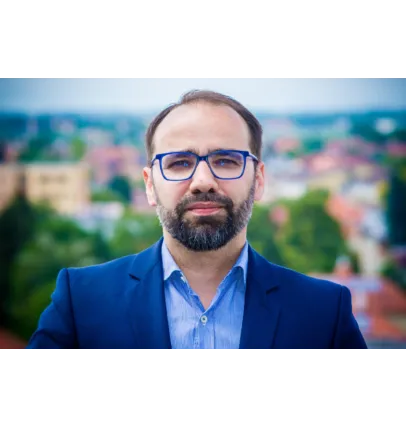
Minority Report was founded by Balázs Jarábik, a recognized authority on Central and Eastern European affairs with over twenty years of experience in international development as well as political economy and policy analysis. Balázs combines rigorous scholarly research with hands-on fieldwork, having managed numerous international programs across Central and Eastern Europe and Central Asia. His insights have been featured in leading media outlets such as Bloomberg, CNN, The Economist, The Financial Times, Foreign Affairs, Politico and The New York Times.
However, Minority Report’s strength goes far beyond one individual. Our team is made up of diverse experts and seasoned practitioners with deep roots and broad networks throughout Eastern and Central Europe. Together, we bring a wealth of practical experience in governance, policy consulting, and strategic intelligence.
At a time of regional uncertainty and transformation, Minority Report draws on its collective expertise and extensive regional networks to deliver nuanced analysis, candid policy advice, and practical governance solutions. We help clients navigate complexity, anticipate emerging challenges, and seize opportunities in a rapidly evolving landscape—delivering not the analysis and advice you want to hear, but the insight you need.
An ethnic Hungarian born in communist Czechoslovakia, Jarábik has spent his life giving voice to minority opinions. Early in his career, he co-authored one of the first comprehensive studies of Roma populations in Slovakia and co-founded the Center for Legal Analysis at the Kalligram Foundation in Bratislava, lobbying for minority rights and anti-discrimination legislation.
He was an active participant in Czechoslovakia’s Velvet Revolution and later worked as a political advisor and activist in Slovakia’s 1998 elections. He also lived and worked in the field during the so-called “Color Revolutions” in Yugoslavia (2000), Georgia (2003), Ukraine (2004), and Kyrgyzstan (2005), and in Uzbekistan (2003), where he managed a human rights program.
Living in Ukraine between the Orange Revolution and Euromaidan pushed Jarábik to go beyond traditional analytical methods to understand what was happening in the country. Similarly, working in Belarus helped him better understand illiberalism and its underlying factors — now spreading westward from Eastern Europe.His time living and working in the Baltic States from 2012 to 2016 deepened his understanding of countries close to Russia and taught him to distinguish between actual and perceived threats to society.